




Author: Priscilla Gaudoin, Head of Risk & Compliance, published March 2026
Topics: T+1 settlement, Governance, Third Party Oversight, Risk Management
Regions and Regulators: UK - FCA, PRA, EU - ESMA
 Time to read: 4 minutes
TL:DR - Moving from T+2 to T+1 means trades settle one business day after execution. The UK and EU have a target implementation date of October 2027. The settlement lifecycle will be reduced by one business day meaning processes must become faster, more automated and more exact first time. Regulators will judge firms on control effectiveness, governance quality and risk understanding. Firms must strengthen their controls and monitoring, whilst maintaining defensible audit trails.
- Introduction
- What is T+1 Settlement
- The European Timeline
- Comparing Europe with the USA
- Key Challenges
- Impact on Market Participants
- Strategic Direction of Regulation
- How Ruleguard Helps
- Download your free Checklist
Introduction
The global securities industry is undergoing a major structural change as markets move towards accelerated settlement cycles. After North America transitioned to T+1 settlement in May 2024, the next major shift will occur in Europe, with the European Securities and Market Authority (ESMA) recommending that the EU, the UK and Switzerland move to T+1 on 11 October 2027.
For asset managers, wealth managers, brokers and custodians, the transition represents more than a technical adjustment. It will fundamentally reshape post-trade processes, operational models and risk management practices.
What is T+1 settlement?
The settlement cycles describe the period between a trade being executed and the exchange of cash and securities.
T+1 settlement occurs one business day after the trade date, rather than two (T+2). Moving to T+1 effectively halves the time available to complete trade allocation, confirmation, funding and reconciliation activities.
The UK has committed to moving to T+1 in 2027, following implementation in the USA during 2024 and alignment efforts across Europe. This shift compresses the entire post-trade lifecycle into a much tighter window.
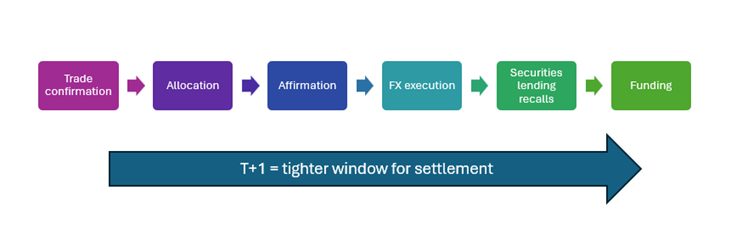
Figure 1: Tighter settlement window
The goal is straightforward and aims to:
- Reduce counterparty risk
- Improve market resilience
- Align globally
- Modernise infrastructure
Operationally, it creates real pressure points.
The European Timeline:
European regulators have coordinated a regional transition to avoid fragmentation across markets.
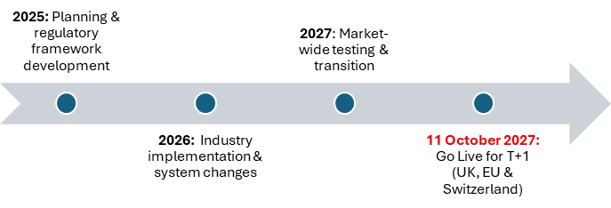
Figure 2: Key milestones
The transition is driven in the EU by amendments to the Central Securities Depositories Regulation (CSDR) and supported by a dedicated governance structure involving regulators and industry participants.
Comparing Europe with the USA
The benchmark for the global transition is the USA. Regulators like the US Securities and Exchange Commission (SEC) oversaw the move to T+1 in May 2024.
Key differences:
|
Factor |
United States |
UK/EU |
|
Go-live date |
May 2024 |
October 2027 |
|
Market structure |
More centralised |
Highly fragmented |
|
Currencies |
Primarily USD |
Multiple currencies |
|
Infrastructure |
Consolidated clearing system |
Multiple CSDs and settlement infrastructures |
|
Complexity |
Lower |
Significantly higher |
Europe’s transition is widely considered more complex because of multiple jurisdictions, currencies and market infrastructures, which increase implementation costs and operational coordination challenges.
However, Europe benefits from lessons learnt during the American transition, which offer valuable operational insights.
Synergies between the UK & EU Transitions:
Despite regulatory divergence following Brexit, the UK, and EU have intentionally aligned their T+1 transition dates.
This alignment creates several important synergies:
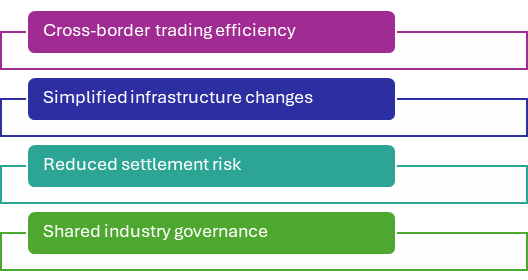 Figure 3: UK & EU synergies
A shared settlement cycle reduces the operational friction for firms operating across London and EU markets. This should result in custodians, brokers and asset managers implementing single process adjustments rather than dual frameworks. Another benefit is that coordinated settlement cycles limit mismatches between jurisdictions.
Industry forums and taskforces across Europe are working collaboratively on standards, testing and implementation planning. These synergies help support Europe’s competitiveness with US capital markets and avoid fragmentation.
Key Challenges
T+1 throws up various challenges. To begin with, there’s time compression risk. Time is the biggest issue for many firms. Everything that used to happen across two days needs to be automated, exception-based and confirmed earlier. Having manual processes multiplies the risks here. 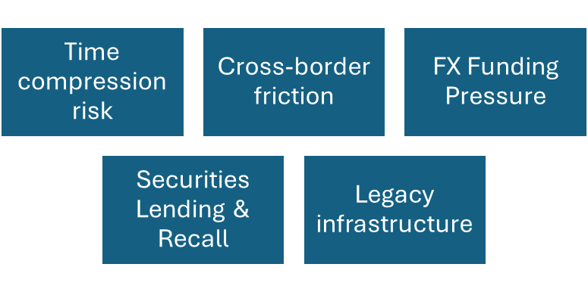
Figure 4: T+1 challenges
Then, we have cross-border trading. North America has already moved to T+1 and the EU is still on T+2 with plans to go live with T+1 in Q4 2027. In the meantime, this creates temporary mismatches and operational complexity.
For foreign exchange trades, FX must be executed sooner. Funding errors become more likely and settlement risk increases if currency isn’t delivered on time.
Under T+1 loaned securities must be recalled earlier. Recall failure means a settlement failure leading to revenue from lending programs being indirectly pressured.
Firms relying on manual allocation process, email based confirmations or fragmented middle office workflows will face a structural disadvantage. This change requires an operational shift.
Impact on market participants:
Asset Managers:
This will affect asset managers operationally, as well as bringing greater risk and additional impacts upon clients.
Asset managers will need to ensure that allocation and affirmation happen on the same day. (T+0). This will require improved efficiency, and firms will seek greater automation in the middle office. There is reduced margin for manual processes and reconciliation delays. Ultimately, this places greater pressure on outsourced administrators and custodians.
In terms of risk, the potential for failed trades is more likely to increase unless processes are revised and efficiency is improved. There is also the added complexity of cross-border funds. A UK asset manager trading in US securities must manage time zone and foreign exchange (FX) cut-off risk. It also means that securities lending recalls must happen faster to avoid settlement failure.
What does this mean for clients? Potentially lower system risk if there are fewer settlement failures. Conversely, there is the potential increase in short-term operational costs, and we could see earlier funding requirements for some mandates.
Asset managers still relying upon spreadsheets, email confirmations, or fragmented systems will struggle.
Investment Banks and Custodians:
Looking at trading and prime brokerage, firms will see a shortened settlement cycle that compresses funding and collateral timelines. This requires increased intra-day liquidity and poses greater exposure to operational bottlenecks.
Managing custody and clearing within the compressed timeframes requires heavier reliance on automation. Clients will need firms to focus attention on greater pre-matching and affirmation discipline.
Potential increased buy-in activity if fails rise during transition. Balance sheets will also be affected. In theory, there will be reduced counterparty exposure and capital usage. However, the transition period may increase volatility in fails.
Wealth Managers:
In terms of portfolio management, faster cash movement is required, and this also brings reduced flexibility for late trade corrections. FX for international securities must be arranged more quickly.
And what about your customers? Their expectations are increasing. Faster settlement may improve their perception of efficiency; however model portfolios should be monitored carefully for any liquidity timing mismatches.
For advisory mandates, firms need to ensure clearer communication. It’s essential that firms provide specific information relating to when funds leave accounts, when proceeds become available and FX timing impacts.
Strategic Direction of Regulation
Regulators seek reduced systemic risk, greater operational discipline, alignment with global best practice and greater emphasis on automation and resilience.
Technology will play a critical role in making T+1 operationally viable. Automated workflows reduce manual intervention and accelerate post-trade processing. Automated affirmation platforms enable same day trade confirmation. Improved messaging standards and shared data models reduce reconciliation delays. Integrated post-trade systems allow firms to track trade lifecycle events in real time. Emerging technologies may support near real time settlement and auditability, though large scale adoption is still gradual. Ultimately, firms with highly automated post-trade infrastructures will adapt more easily to T+1.
How Ruleguard helps firms:
Ruleguard is a GRC platform. It can’t help with executing trades faster, but it can help you control the risks created by T+1. T+1 requires alignment across the entire trade lifecycle.
- Deploy Ruleguard to create a single source of truth of controls. T+1 exposes fragmentation. Ruleguard can centralise policies, processes, controls and evidence.
- Map regulatory changes to real processes. T+1 affects settlement processes, client asset controls, counterparty risk and outsourcing arrangements. Ruleguard’s regulatory mapping capabilities enable firms to link rules to risks, controls and processes.
- Map and assess the impact of cross-border settlement risk arising from different trading settlement cycles.
- Strengthen control assurance. With less time to fix errors, firms need stronger preventative controls and faster control testing and validation. Ruleguard enables compliance monitoring plans, control testing workflows and captures evidence for your audit trail.
- Improve exception and issue management. T+1 increases the risk of settlement fails, breaks, and operational incidents. Ruleguard helps firms to track issues, assign ownership, escalate quickly and evidence remediation.
- Enhance third party and outsourcing oversight. Your operations may be reliant upon custodians, administrators and brokers. Ruleguard supports supplier oversight, control mapping across third parties, and accountability tracking.
- Build audit-ready evidence. Under compressed timelines, regulators will focus on operational resilience, control effectiveness and governance. Ruleguard provides structured audit trails, evidence management and board-level reporting.
With everything needing to be done in half the time, firms are under greater pressure to consider all risks and contingencies to avoid reputational risk.
Firms that proactively engage with consultations and adapt early will gain competitive advantage in a more streamlined, innovation-friendly regulatory environment.
Ruleguard is a comprehensive solution that lets you protect and propel your business forward through the complex regulatory landscape.
Get Your T+1 Readiness Checklist
The move to T+1 settlement will compress timelines across the entire trade lifecycle, leaving little room for manual processes and operational gaps.
To help you prepare, we’ve created a practical checklist covering the key areas firms must address ahead of 2027.
✔ Governance and programme setup
✔ Trade allocation and affirmation
✔ Post-trade operations and settlement
✔ Liquidity and funding readiness
✔ Technology, data, and third-party dependencies
✔ Testing and implementation
Download the checklist to assess your readiness and identify next steps.

About the Author


.jpg)