




Author: Priscilla Gaudoin, Head of Risk & Compliance, published August 2026
Topics: Accountability, Governance, Integrity, Cross-border Risk
Regions and Regulators: IOSCO, FCA, ESMA
Time to read: 4 minutes

TL:DR IOSCO’s consultation on commodity derivatives signals a clear regulatory shift over the next 2–5 years. More transparency, stronger surveillance, and tested governance, especially in OTC markets.
Supervision is trending toward proactive monitoring of large positions, concentration risk and potential market abuse. Requiring clearer triggers, escalation paths and ownership. The biggest obstacles are data fragmentation and the governance-vs-reality gap (where controls exist on paper but fail under time pressure or poor data). Best-positioned firms will treat this as a data + operating model transformation, investing in integration, surveillance analytics and regulator-ready management information.
- Introduction
- Why IOSCO is acting now
- Core themes
- What this means for firms
- Key challenges
- Strategic opportunities
- How Ruleguard can help
IOSCO's consultation
The International Organisation of Securities Commissions (IOSCO) launched a consultation (News Release 787) in March setting out good practices for commodity derivatives markets, with a particular focus on over the counter (OTC) markets.
Whilst IOSCO standards are not directly binding, they are highly influential. They typically shape the direction of travel for national regulators, including the Financial Conduct Authority (FCA) and the European Securities and Markets Authority (ESMA).
This consultation is therefore less about immediate rule changes and more about what regulation will be like in the next 2-5 years.
Why IOSCO is acting now
Commodity derivatives markets have come under increasing scrutiny due to:
-
Volatility driven by geopolitical shocks and energy markets
-
Concerns about transparency in OTC positions
-
Risks of market manipulation and disorderly trading
IOSCO’s earlier reviews found that whilst many jurisdictions broadly comply with existing principles, there are persistent weaknesses, particularly in OTC markets:
- Limited visibility of positions across venues
- Fragmented data between trade repositories and exchanges
- Cross border data gaps and inconsistencies
- Operational practices
- Supervisory usability
- Real-world data challenges
- Future regulatory trajectory
- Summary
- How Ruleguard can help
The consultation therefore aims to provide practical guidance to close these gaps and strengthen market oversight.
Core Themes:
|
IOSCO theme |
Direction of travel: |
Firms should demonstrate: |
|
Transparency |
Greater visibility of OTC positions and exposures across venues, higher bar on data quality and accessibility. |
End-to-end position view (OTC + exchange), reconciled and explainable, clear data lineage, timely MI for oversight. |
|
Surveillance |
More proactive monitoring of large positions, concentration risk and potential market abuse. |
Defined alerts/triggers, escalation routes and ownership, evidence of monitoring outcomes and interventions. |
|
Governance & accountability |
Clear responsibility for position oversight and decisions, stronger expectation to evidence judgement. |
Who decided what (and why), supported by documented rationale; oversight forums that operate effectively in practice. |
|
Cross-market / cross-border risk |
Joined-up supervision across venues and jurisdictions; fewer blind spots from fragmented data. |
Consistent data definitions and aggregation across entities/regions; ability to respond to regulators with one coherent view. |
Although framed as ‘good practices’ it is clear that there is a higher expectation around transparency, governance and control.
Enhanced transparency in OTC markets requires greater visibility of positions across trading venues. Meaning that improved access to data for both regulators and market operations becomes a necessity.
Stronger governance and oversight means that there must be clear accountability for monitoring large positions. This should enable better detection of market abuse and concentration risk.
Cross-market and cross-border risk monitoring. There needs to be recognition that risks do not sit neatly within one venue, and supervision needs to be joined up across jurisdictions.
There needs to be more focus on practical implementation. Unlike earlier high-level principles, this consultation emphasises:
- Operational practices
- Supervisory usability
- Real-world data challenges
What this means for firms:
Transparency expectations will rise materially.
Firms should expect increased scrutiny of OTC positions and exposures and greater expectations around data quality, completeness and accessibility.
The focus here is about being able to explain positions, aggregate exposures and demonstrate understanding of market impact.
We’re seeing a shift from reporting data to demonstrating insights. What is your data telling you?
Surveillance Obligations will increase
Regulators are clearly signalling a move towards proactive market surveillance (FCA market watch, ESMA) with increasing focus on large positions and concentration risk.
Firms need to improve their internal monitoring tools, review their escalation frameworks and ensure clear ownership of market risk oversight.
Governance will be tested
Firms need to review their governance frameworks to confirm that they’re able to withstand regulatory scrutiny. Governance will be tested which means evidence needs to be readily available.
The consultation reinforces expectations that firms can identify risks early, act before markets become disorderly and evidence their decision-making.
This aligns with a broader regulatory trend of judgment and accountability over prescriptive compliance.
Cross-border complexity will increase
Commodity derivatives market are inherently global. Firms operating across jurisdictions will face diverging implementation of IOSCO guidance, different data and reporting expectations as well as challenges in aggregating exposures globally.
Key challenges for firms
Data fragmentation will be the biggest issue. Firms already struggle with multiple data sources, inconsistent formats, gaps between OTC and exchange-traded data. IOSCO explicitly highlights that even regulators face difficulty accessing complete OTC data. For firms this is a strategic data problem.
Inability to aggregate risk effectively. Many firms cannot combine positions across desks, entities and jurisdictions or identify ‘true exposure’ in real time. This becomes critical as expectations shift towards holistic risk visibility.
Governance vs reality gap. On paper, firms often have committees, policies and escalation frameworks. How well do they operate in practice?
In reality, data arrives too late, decisions are reactive and accountability Is blurred. IOSCO’s direction will expose this gap quickly. Firms need to be on the front foot.
Cost and operational burden
Implementing the proposed changes will mean additional cost and operational burden. These expectations will require investment in data infrastructure, enhanced surveillance tools, and more sophisticated analytics.
This will not be easy for firms, especially those with legacy systems.
Regulatory interpretation risk. As with many IOSCO-driven reforms, these are high level principles and local interpretation will vary according to local needs and markets. This brings additional challenges for firms needing operating cross-border. Firms may find themselves complying in one jurisdiction and failing in another.
Strategic Opportunities
This is where strong firms will differentiate themselves.
Data as a competitive advantage
Firms can differentiate themselves by turning data into competitive advantage. Firms will gain the upper hand if they invest early in data integration, real-time analytics and exposure aggregation. This will enable firms to have better trading insight, faster decision making and stronger regulatory positioning.
Moving from compliance to market intelligence.
There is a real opportunity here for firms to shift a gear. Moving from reporting positions to understanding market dynamics. This enables firms to anticipate volatility,, manage concentration risk proactively and improve client outcomes.
Strengthening credibility with regulators.
Firms that can demonstrate clear oversight, robust governance and data driven decision making will benefit from greater supervisory confidence and reduced intervention risk.
Alignment with broader regulatory trends
This consultation aligns with increased focus on market integrity, greater emphasis on system risk monitoring a shift toward outcomes-based supervision.
Firms that adapt here will be better positioned across conduct regulation, prudential oversight and market surveillance frameworks.
Key next steps
Immediate actions should include reviewing current OTC data capabilities, assessing ability to aggregate positions globally, identify gaps in surveillance and escalation frameworks.
Firms need to think strategically about investing in data architecture and integration. Strengthening governance and accountability models, aligning front office, risk and compliance functions.
Future Regulatory Trajectory:
Based on IOSCO’s role and history, these ‘good practices’ are highly likely to be adopted, or adapted, by national regulatory bodies. They will influence supervisory expectations even before formal rules are drafted.
In terms of timelines, this consultation closed on 19 June 2026 and we can expect a final report within 12 months, which will then be followed by gradually incorporated into local regimes.
How expectations translate into operating model change: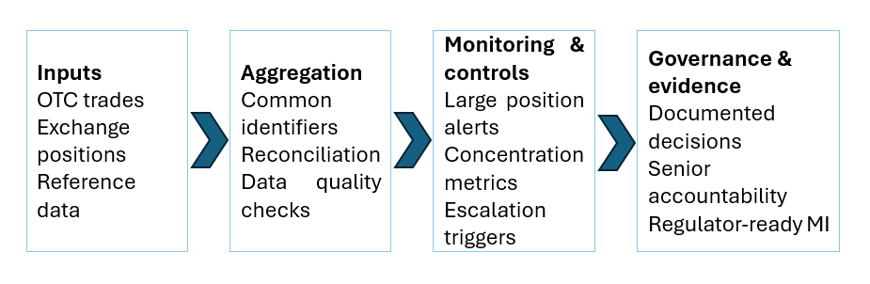
Summary:
The IOSCO consultation signals a clear direction that markets must be transparent as well as clearly understood. Those firms that treat this as a data, governance, and intelligence transformation will gain a meaningful advantage.
Investment banks and broker-dealers who are active in commodity derivatives (OTC and exchange trades), or act as intermediaries need to consider the impacts upon market surveillance obligations and cross-border exposure aggregation. The infrastructure exists but gaps will be exposed, especially in OTC aggregation.
For asset managers and hedge funds who use commodity derivatives for hedging, speculation, macro strategies will need to be aware of the increasing focus on large positions and concentration risk. Regulators will expect clearer visibility into strategies and exposures. This is especially relevant for funds with material of directional commodity exposure.
And whilst market Infrastructure providers may not be directly impacted, they may feel pressure to improve data quality, accessibility and cross market integration.
How Ruleguard can help
Ruleguard's Operational Risk Management Solution supports firms by turning the issues highlighted in the IOSCO consultation into a living risk and control framework.
Ruleguard helps firms by linking risks to controls, processes, regulatory requirements, assessments, evidence and management information. Ruleguard enables firms to demonstrate not only that controls exist, but that they are operating effectively in practice.
- Dynamic risk register: enables firms to maintain a current view of operational risks
- Control mapping and gap analysis: connects controls to the risks they are designed to mitigate, making it easier to identify where the control framework does not adequately cover regulatory obligations
- Risk and control self-assessments: provides a structured way to test whether documented controls are working in practice
- Evidence-led oversight: captures assessments, decisions, actions, issues and supporting material in one place
- Loss event and issue tracking: helps firms record operational failures, near misses, control weaknesses and remediation activity
- Board and senior management MI: converts live risk and control data into reporting on risk exposure, control effectiveness, assessment status and emerging issues, supporting stronger accountability and more timely decision-making.
For firms affected by IOSCO’s direction of travel, this means operational risk management becomes more than a periodic risk register exercise. Ruleguard helps firms evidence a connected, responsive and regulator-ready operating model, where risks are identified, controls are mapped, assessments are completed, issues are tracked and senior management can see whether the framework is working.
Ready to see where you stand?
Download the free IOSCO Commodity Derivatives Governance Checklist and benchmark your firm's readiness across the ten areas regulators are increasingly focused on.
Book a tailored discovery call
Ready to turn GRC into a board-level advantage?
Book a tailored discovery call with Ruleguard to see how leading firms unify risk and compliance, surface the insights executives care about, and stay audit-ready, without the spreadsheet sprawl.

About the Author